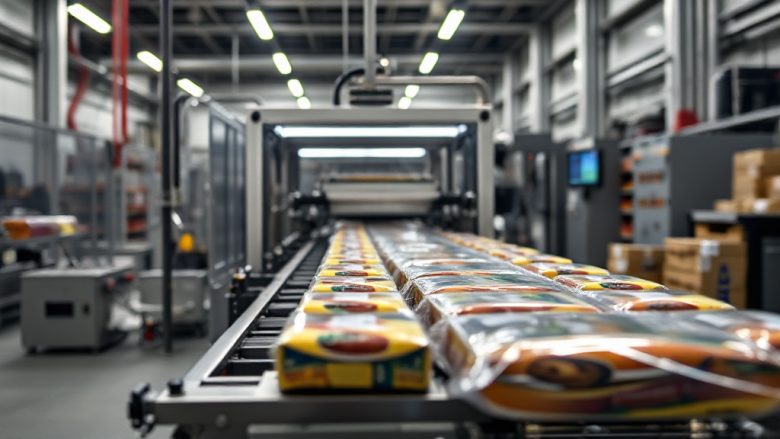
What an Automatic Shrink Wrapping Upgrade Really Costs
A production manager is staring at a quote for an automatic shrink wrapping line and wondering whether the labor savings and film waste reductions will justify the capital outlay. That decision usually comes down to a payback calculation: how many months of operational savings will cover the purchase price? A Shrink wrapping machine upgrade is not just a capital expense; it is a throughput and waste equation that can be modeled before you sign the purchase order.
This worked example walks through the cost buckets, throughput assumptions, and payback logic that finance-minded operations teams use when evaluating an automatic shrink wrapping line. The numbers are illustrative, but the structure is what matters for your own factory floor.
Building the Cost Buckets for an Automatic Shrink Wrapping Line
Before calculating payback, separate the investment into clear buckets. Most buyers underestimate the ancillary costs and overestimate the labor savings, so a disciplined breakdown prevents surprises.
Capital equipment and installation
The core cost is the Automatic Shrink Wrapping machine itself, which includes the wrapping unit, film delivery system, and control panel. Add the shrink tunnel Machine that heats the film around the product, plus conveyors, infeed and outfeed tables, and electrical or pneumatic connections. Installation often requires compressed air lines, dedicated power circuits, and floor space reconfiguration. Budget 10–20% of the equipment price for installation and commissioning, depending on how much existing infrastructure you can reuse.
Film and consumables
Shrink film is a recurring cost that changes with machine efficiency. Automatic lines typically reduce film waste because they cut and wrap consistently, but the film type and gauge matter. A machine that handles center-folded film may use less material per pack than a manual operation that over-wraps. Ask the supplier for a film consumption estimate per shift, then multiply by your planned production volume and current film price.
Labor and training
Automatic lines reduce manual handling, but they do not eliminate operators. You may need one operator to monitor the line, load products, and handle changeovers, plus a technician for maintenance. Training costs are a one-time expense, but ongoing labor is a variable cost that affects payback. Compare the number of workers currently needed for manual wrapping against the projected headcount for the automatic line.
Maintenance and spares
Shrink tunnels have heating elements, blowers, and conveyor belts that wear over time. Budget an annual maintenance allowance of 3–5% of the equipment cost, and keep critical spares like heating elements, thermocouples, and belts on hand. A machine that is down for a week can erase months of savings, so uptime assumptions belong in the payback model.
Throughput Assumptions That Drive the Payback Math
Payback depends on how many packs per hour the line can produce and how much of that capacity you actually use. Use conservative assumptions; optimistic throughput figures are the most common reason payback projections fail.
Current manual throughput vs. automatic capacity
Measure your current output: packs per hour, labor hours per shift, and film usage per pack. Then get the rated speed of the automatic line from the supplier. A typical automatic shrink wrapping line may run at 15–30 packs per minute, but actual output depends on product size, film type, and changeover frequency. Assume you will achieve 70–80% of rated speed during normal operation to account for startup, jams, and breaks.
Operating hours and utilization
Calculate the number of production hours per year. If you run one shift of 8 hours, 250 days a year, that is 2,000 hours. Multiply by the achievable packs per hour to get annual capacity. Then compare that to your actual demand. If demand is lower than capacity, the payback period extends because you are not fully using the machine’s throughput.
Labor savings calculation
Suppose manual wrapping requires four workers per shift at a fully loaded cost of $20 per hour. That is $80 per hour, or $160,000 per year for 2,000 hours. An automatic line might need one operator at $20 per hour, or $40,000 per year, plus a maintenance technician at 20% of their time. The gross labor savings are the difference, but remember to subtract training and any new roles created.
Film waste reduction
Manual wrapping often wastes 10–15% of film due to inconsistent cutting and over-wrapping. An automatic line can reduce waste to 3–5%. Multiply your annual film spend by the waste reduction percentage to estimate savings. For example, if you spend $100,000 on film annually and cut waste from 12% to 4%, you save $8,000 per year.
Worked Example: Payback Period for a Mid-Size Operation
Consider a factory that runs two shifts, 250 days a year, for 4,000 production hours. The current manual process uses six workers per shift at $20 per hour and consumes $150,000 in film annually with 12% waste.
Investment and annual savings
The automatic line quote is $250,000 for the shrink wrapping machine and tunnel, plus $30,000 for installation, totaling $280,000. The new line requires two operators per shift, saving four workers per shift. Annual labor savings: 4 workers × $20/hour × 4,000 hours = $320,000. Film waste drops to 4%, saving 8% of $150,000, or $12,000. Maintenance and spares add $10,000 per year. Net annual savings: $320,000 + $12,000 − $10,000 = $322,000.
Payback reasoning
Simple payback: $280,000 ÷ $322,000 ≈ 0.87 years, or about 10.5 months. That looks attractive, but test the assumptions. If the line achieves only 70% of rated speed and demand does not fill capacity, labor savings may be lower because you still need workers during peak periods. If film prices rise, savings increase; if maintenance costs are higher, payback extends. A sensitivity analysis with pessimistic, base, and optimistic scenarios gives a range, often 10–18 months for a well-utilized line.
Hidden costs and risks
Do not forget floor space, potential downtime during installation, and the cost of retraining staff. Also consider the residual value of the old equipment and any tax incentives for capital investment. A payback calculation is a guide, not a guarantee; the real number emerges from your actual production data after three to six months of operation.
When you evaluate a shrink wrapping machine upgrade, treat the payback model as a living document. Update it with real throughput and waste figures once the line is running, and use those insights for the next automation decision. The finance-minded operations manager who builds the model before signing the quote is the one who avoids surprises and captures the savings.